training · targets
Training targets for intermediate shooters: dots, transitions and the timer
Printable A4 targets and drills for shooters who already group well: a dot drill, transitions between targets, pairs and reloads, against the clock. Part two of a series.
4 min read ·
Once your group lands in the 5 cm circle from 5 meters every time, it's time to add pressure: time, moving between targets, reloads, one-handed shooting. The targets don't change much, but now you measure two things together: did you hit, and how long did it take.
This is part two of a series. Before it: training targets for beginners. After it: targets and drills for advanced shooters.
The targets
| Target | What's on it | What for |
|---|---|---|
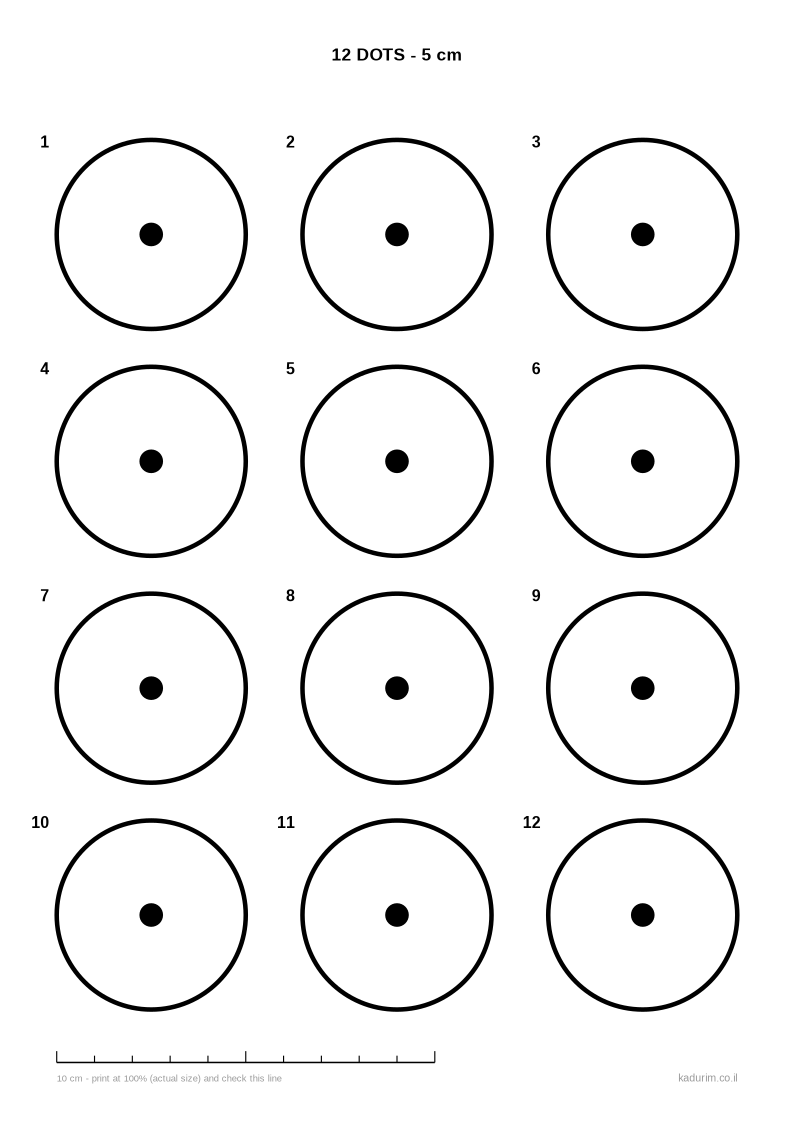
| 12 dots | 12 numbered 5 cm circles | The dot drill: each circle is a different task |
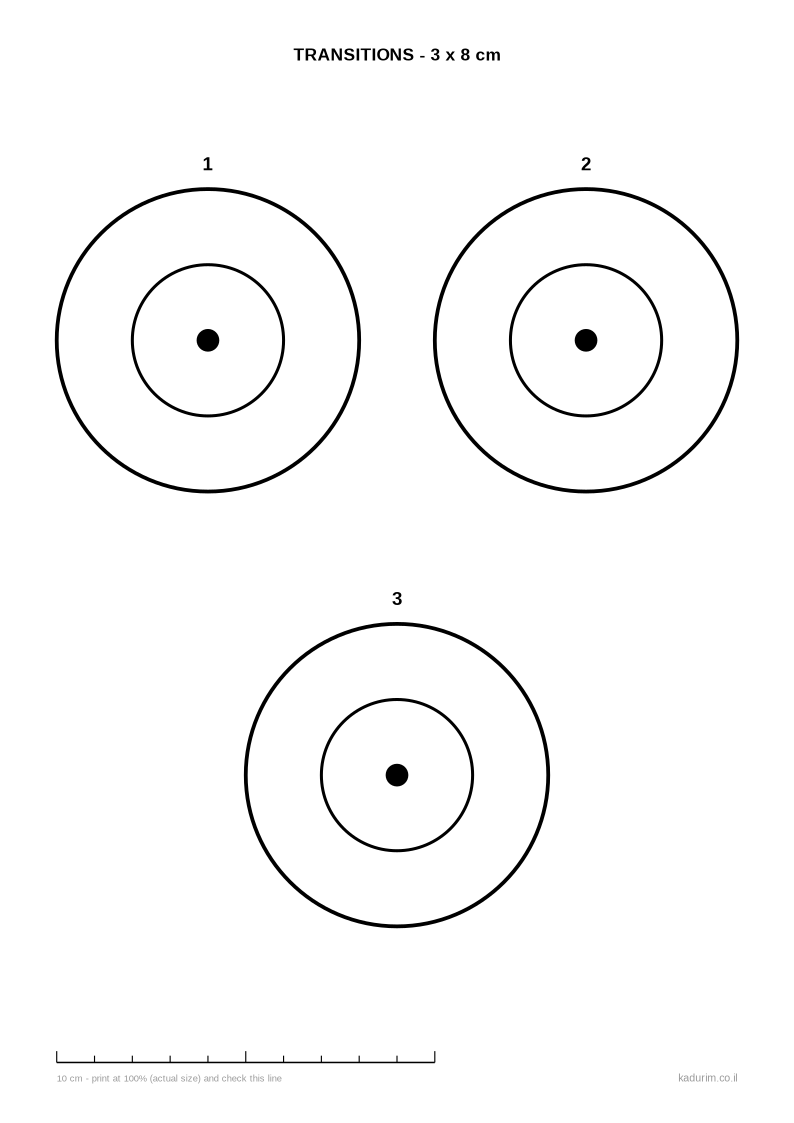
| Transitions | Three 8 cm circles with 4 cm cores, spread apart | Moving the gun from target to target and stopping right on it |
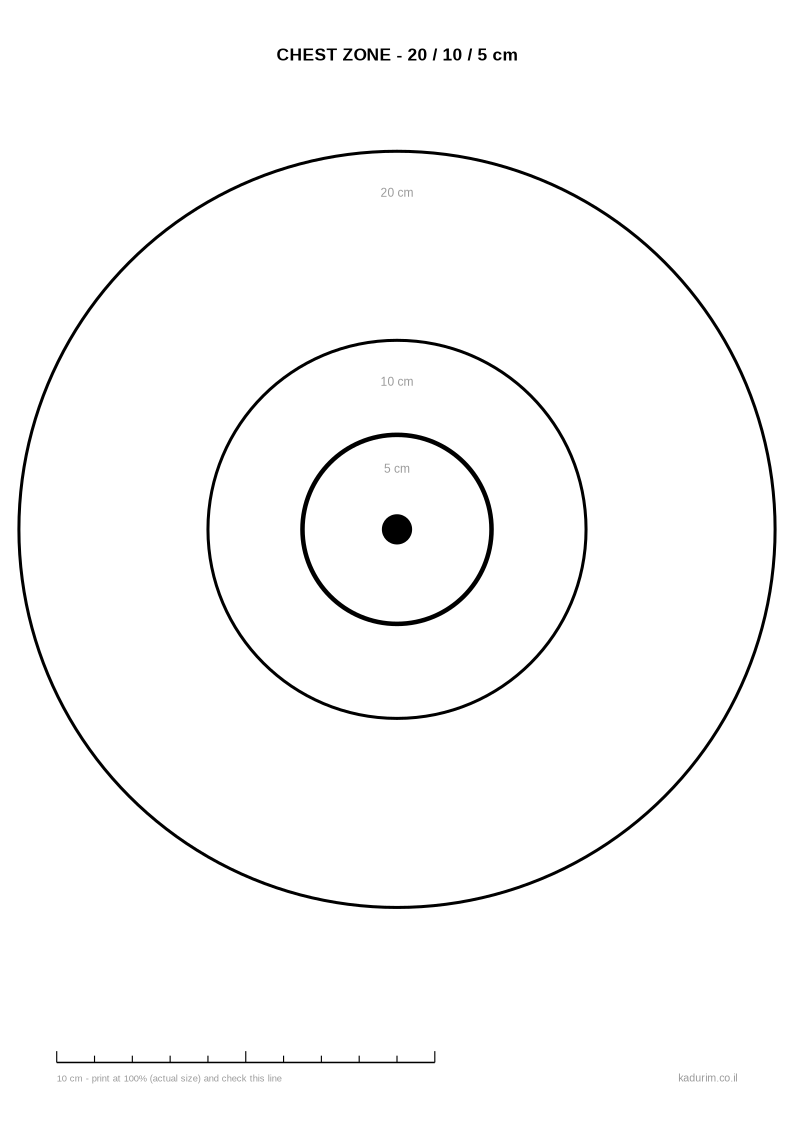
| Chest zone | 20, 10 and 5 cm circles | Pairs and reloads against the clock |
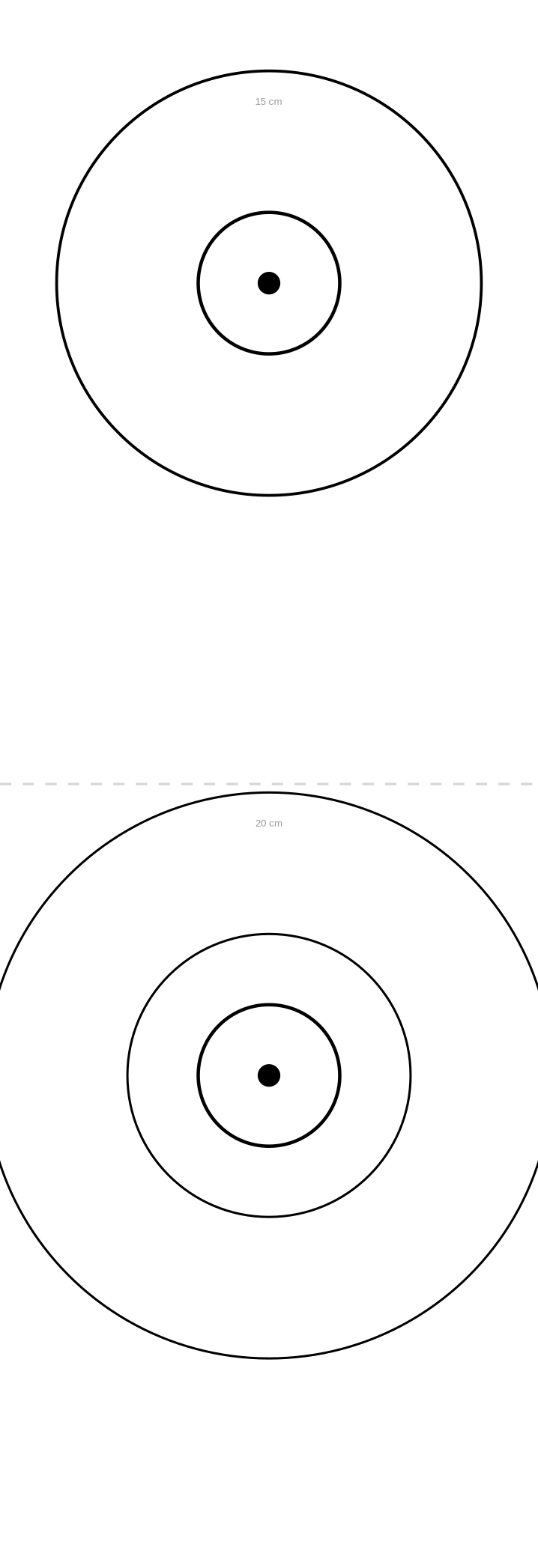
| Head and chest | A 15 cm head circle above chest circles, on two sheets | Moving between a big and a small target, and slowing down when it's small |
Print at 100% and check the 10 cm line. "Head and chest" is put together from two sheets; the instructions are on the first page of the file.
The timer
From here on you need to measure time. A shot timer app on your phone is enough: it beeps to start and records your shots. Write down time and hits, and compare across sessions. A hit outside the zone costs more than a tenth of a second. If your hits drop, slow down.
Drills
Every drill here starts from low ready (gun in both hands, muzzle pointed down toward the target). At many ranges in Israel drawing from the holster is only allowed on certain lanes; if it's allowed and you're trained for it, you can start from the holster.
Dot drill (50 rounds, 3–5 m)
On the 12-dot target, in order. Each circle (or pair of circles) is a task, 50 rounds in all:
| Circle | Task | Rounds |
|---|---|---|
| 1 | Five slow shots | 5 |
| 2 | Five slow shots | 5 |
| 3 and 4 | One shot on 3, one on 4, alternating, four times | 8 |
| 5 | A pair from low ready, three times | 6 |
| 6 | Strong hand only, five shots | 5 |
| 7 | Weak hand only, five shots | 5 |
| 8 | Shot, reload, shot; twice | 4 |
| 9 and 10 | A pair on 9, a pair on 10, twice | 8 |
| 11 and 12 | Two slow shots on each | 4 |
No timer. The goal: 50 out of 50 inside the circles. When you get there, step back.
The idea comes from the Dot Torture drill, developed by David Blinder, whose version was spread by Todd Louis Green on Pistol-Training.com; that's where you'll find the original drill, its target and what each dot is for. The version here is adapted to our metric target and shooting from low ready.
5 / 5 / 10 (25 rounds)
Five shots, from 5 meters, into the 10 cm circle on the chest-zone target, within 5 seconds. Five times. Any shot outside the circle or over time is a miss. Twenty-five out of twenty-five is a good goal before moving on to the advanced stage.
Transitions (30 rounds, 5 m)
On the transitions target: a shot on circle 1, a shot on 2, a shot on 3, and back. Your eyes move before the gun, and the gun stops on the core before you press. Start slow, then cut the time. Next round: a pair on each circle.
Head and chest (24 rounds, 5 m)
A pair to the chest, then one shot to the head. Six times, against the clock. Moving from big to small forces you to slow down: on the chest an "okay" sight picture is enough, on the head you need a full one.
What to write down
For each drill: date, distance, best time and how many hits. In the Kadurim vault you can log the session and track each gun's round count.
Before you print: some ranges only let you shoot their own targets, or ones the range officer has approved. Ask first.
Credits
- Dot Torture: developed by David Blinder; the well-known version is Todd Louis Green's, on Pistol-Training.com. More background: Active Response Training.